

Follow Us On:




Posted On: May 28, 2026
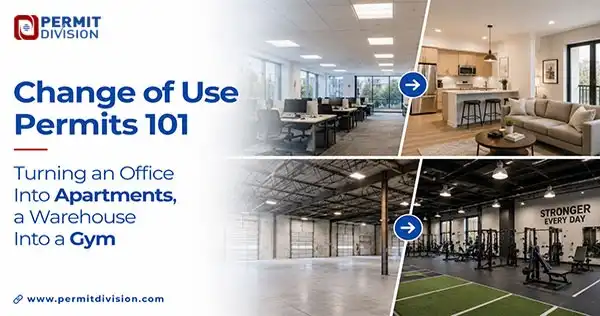
Change of Use Permits 101 — Turning an Office Into Apartments, a Warehouse Into a Gym.
The Building Didn't Change. The Permit Rulebook Did.
A Chicago developer bought a 12-storey office tower in 2021 for $36 million. By 2023, he was watching 190 apartments take shape inside it. The concrete core stayed. The elevators stayed. What changed was the building's legal identity, and that shift triggered a permit process most property owners completely underestimate.
Adaptive reuse is accelerating. Vacancy rates in U.S. office markets hit 19.6% in 2023, the highest on record. Developers are converting empty offices into apartments, warehouses into gyms, and retail floors into medical clinics. But the physical work is only half the project. The permit work is the other half, and it's the one that kills timelines.
This guide covers what change of use permits actually require, where projects stall, and how professional commercial permitting services keep conversions moving.
What a Change of Use Permit Actually Is
Building codes classify every structure by occupancy type. An office building is a Group B occupancy. Apartments are Group R. A warehouse is Group S. A gym is Group A-3.
When a building shifts from one category to another, local building departments treat it as a new project. They reassess the entire structure against current code, system by system.
Code Compliance Gets Reassessed From Scratch
A warehouse built in 1980 didn't need residential fire suppression, ADA-compliant restrooms, or egress windows. A gym does. The building doesn't automatically meet those standards because you gut the interior and install treadmills.
A typical change of use review hits every major system:
- Fire and life safety: sprinkler upgrades, exit signage, occupant load calculations
- Structural: floor load ratings, seismic requirements where applicable, roof capacity
- Mechanical and electrical: HVAC zoning, ventilation rates, electrical panel capacity
- Accessibility: ADA path of travel, restroom compliance, accessible parking counts
Each of these can generate its own back-and-forth with the building department. None of them move on the same schedule.
Zoning Approval Comes First
Before any building department looks at your drawings, zoning has to clear the use. Residential and commercial zones don't always overlap. A warehouse district may allow light industrial and retail but block residential outright. You may need a conditional use permit or a variance before the building permit application is even accepted.
Skipping zoning review, or doing it simultaneously with building permit filing, is one of the most common and expensive mistakes in adaptive reuse.
The Review Process Is Not Linear
Change of use projects trigger multiple agency reviews at once. Building, fire marshal, zoning, and sometimes environmental or historic preservation all run concurrent tracks. Each department has its own queue and its own checklist. Expedited permits exist because navigating those overlapping reviews without a guide costs months of calendar time and often triggers resubmissions that could have been avoided.
Two Projects, Two Very Different Permit Journeys
Case Study 1: 25 Water Street, Manhattan
25 Water Street is one of the largest office-to-residential conversions in U.S. history. The 22-storey lower Manhattan office tower is being converted into more than 1,300 apartments, with construction underway as of 2023.
The permitting process required coordination across multiple New York City agencies: the Department of Buildings, the Fire Department, and the Landmarks Preservation Commission, since the building sits in a historic district. The development team used professional permit expediting services to manage simultaneous review cycles and catch code gaps before they became stop-work orders.
The team also secured zoning accommodations under New York City's adaptive reuse provisions before construction drawings were finalised. That sequencing alone saved the project an estimated six to eight months. Getting zoning cleared first meant the construction documents were written to an already-approved use, not revised after the fact.
Case Study 2: A Warehouse Becomes a Gym in Brooklyn
In 2019, a fitness operator leased 8,400 square feet of warehouse space in Bushwick, Brooklyn, to open a CrossFit affiliate. The space had 18-foot ceilings, a concrete slab floor, and no sprinkler system.
The city required a full change of occupancy from Group S (storage) to Group A-3 (assembly/fitness). That meant a new sprinkler system, an occupant load calculation for 150 people, two ADA-compliant restrooms, and an egress redesign.
The operator filed the initial permits without an expediter. The application sat in review for four months before a code consultant flagged missing structural documentation. After bringing in a permit expediting firm, the resubmission resolved the structural gap, and approvals came through in six weeks. The gym opened three months behind its target date. The owner later said the four-month delay before hiring an expediter cost more than the expediter's entire fee would have been from day one.
That pattern shows up constantly in change of use projects. The savings from skipping professional permit help rarely survive contact with the first resubmission.
About Permit Division
Permit Division works with developers, contractors, and property owners on commercial permitting services nationwide. The team handles change of use applications, zoning variance filings, multi-agency coordination, and permit tracking for adaptive reuse and ground-up construction projects.
If your project involves a change of occupancy, talk to Permit Division before you finalize your construction drawings. Getting the permit strategy right at the front end is the fastest way to keep the project on schedule and avoid the resubmission cycle that eats budgets.
Frequently Asked Questions
How long does a change of use permit take?
It depends on the jurisdiction and project complexity. Simple conversions in smaller cities can move in six to twelve weeks. Complex projects in major metros with multiple agency reviews typically run six months to a year. Engaging permit expediting services early in the process compresses that timeline.
Do I need a change of use permit if I'm not doing major construction?
Yes. The change of occupancy classification triggers a permit regardless of physical scope. Even cosmetic-only conversions require an official change of use application in most jurisdictions.
What's the difference between a change of use permit and a building permit?
A building permit covers construction work. A change of use permit covers the legal reclassification of a building's occupancy type. Most change of use projects require both, filed concurrently or in sequence depending on local rules.
Can zoning block a change of use even if the building is structurally sound?
Yes. A warehouse that's perfectly safe as a warehouse may sit in a zone that prohibits residential or assembly uses. Zoning approval is a separate track from building code compliance, and it has to clear first.
When should I bring in a permit expediter?
Before you submit anything. Permit expediters identify code gaps, flag missing documentation, and manage agency relationships before problems become delays. The cost of hiring one upfront is almost always less than the cost of resubmissions and schedule slippage.
Ready to Convert Your Building?
Change of use projects move faster when the permit strategy is locked in before the first set of drawings goes out. Permit Division manages the full permit cycle, from zoning clearance to final certificate of occupancy.
Contact Permit Division today and get your conversion on track before the first shovel hits the ground.
📲 Call us at +1 (844) 573 7648 / +1 (202) 967 6566 (Cell/WhatsApp).
🌐 https://www.permitdivision.com/
Licensed Permit Expediters serving clients nationwide, including DC, Maryland, Virginia, and surrounding locations.
Article Author

Arobit
Blog Admin
Tags
Latest Posts





Copyright 2026 -
permit division. All Rights Reserved.Get Your Free Consultation

