

Follow Us On:




Posted On: June 06, 2026
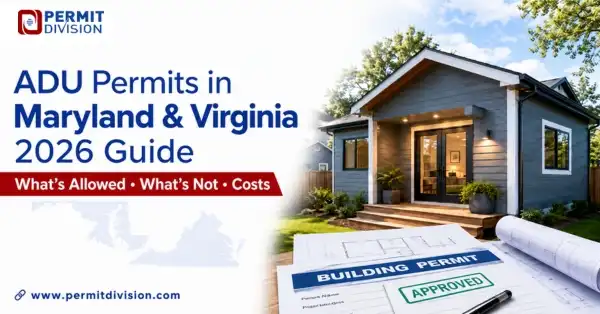
ADU Permits in Maryland and Virginia: What's Allowed, What's Not, and What It Costs in 2026
Since Virginia mandated ADU-friendly zoning in July 2023 and Maryland followed with statewide ADU allowances in 2024, permit applications across the DMV have surged. Property owners in both states now have more legal pathways to build accessory units than at any point in the last decade. But state mandates did not erase county-level complexity. "Allowed by state law" and "approved by your county" are two different conversations.
What Maryland Allows in 2026
Maryland's HB 668 required all municipalities to allow ADUs in single-family residential zones by July 2024. That opened the door for property owners across Montgomery County, Prince George's County, Baltimore City, and beyond.
You can build:
- Attached ADUs: basement conversions, above-garage units, side additions
- Detached ADUs: standalone backyard structures
- Interior conversions: attic, garage, or carriage house buildouts
Most Maryland jurisdictions cap ADU size at 50% of the primary dwelling or 1,200 sq ft, whichever is smaller. Setbacks, lot coverage limits, and height restrictions vary county by county.
Montgomery County's Department of Permitting Services (DPS) requires a zoning clearance letter before any building permit application goes in. Miss that step, and the application sits in a queue while the review clock resets.
What Virginia Allows in 2026
Virginia went further. HB 1557, effective July 1, 2023, required all Virginia localities to allow ADUs in every residential zoning district. Fairfax County, Loudoun County, Arlington, and Alexandria all updated local ordinances in response.
In Virginia, you can typically build:
- Detached ADUs up to 1,500 sq ft in many Northern Virginia jurisdictions
- Attached ADUs with a separate entrance
- Conversions of existing accessory structures, including garages and carriage houses
Some Northern Virginia localities allow two ADUs per lot for larger parcels. Many still require owner occupancy of either the primary residence or the ADU. Fairfax County also imposes an ADU registration requirement through the Zoning Administration Division, separate from and prior to the building permit.
What's Not Allowed
State mandates left room for local restrictions, and both states use it.
Maryland restrictions:
- Several jurisdictions prohibit ADUs on lots under 6,000 sq ft
- Short-term rental of ADUs is restricted or prohibited in certain counties
- Properties in floodplain areas require additional COMAR review before a permit is issued.
Virginia restrictions:
- ADUs cannot exceed 50% of the primary structure's gross floor area in most localities
- Short-term rental of ADUs is banned outright in several Virginia counties
- Properties on private wells or septic systems require a Virginia Department of Health (VDH) review before a permit is issued.
Owners who skip confirming these restrictions often face stop-work orders or certificate of occupancy holds deep into construction.
What It Costs in 2026
Permit fees vary by jurisdiction. Current benchmarks:
Maryland
- Zoning clearance: $150 to $400
- Building permit for ADU under 1,000 sq ft: $600 to $1,800
- Electrical and plumbing sub-permits: $200 to $600 each
- Plan review: $300 to $900
Virginia
- ADU registration where required: $100 to $250
- Building permit for detached ADU: $500 to $2,000 based on project valuation
- Electrical, mechanical, and plumbing sub-permits: $150 to $500 each
- Zoning review: $200 to $500
A complete Maryland ADU permit package typically runs $1,500 to $4,000 in fees alone. Virginia projects sit in a comparable range. Construction costs are entirely separate.
Delays are the real budget risk. A six-week resubmission cycle on a rejected plan adds $3,000 to $8,000 in contractor carrying costs on a typical ADU build.
Case Study 1: Silver Spring, MD — Garage Conversion
A homeowner in Silver Spring converted a detached two-car garage into a 650 sq ft ADU for rental income. The project required a Montgomery County zoning clearance, building permit, and sub-permits for electrical, plumbing, and HVAC.
Their first submission was rejected. The plans showed the ADU 8 feet from the rear property line. Montgomery County requires 15 feet for detached structures in the R-60 zone. Four weeks passed while the architect revised the plans.
They brought in a permit expediter in MD for the second round. The expediter caught two additional code discrepancies before resubmission, coordinated a pre-application meeting with DPS plan reviewers, and tracked the application through each review stage. Final approval came nine weeks after the corrected submission. The project broke ground 13 weeks ahead of where the unassisted timeline was tracking.
Case Study 2: Ashburn, VA — Detached ADU on a Private Well
A property owner in Ashburn, Loudoun County, built a detached 800 sq ft ADU for a family member. The lot runs on a private well, which triggered a VDH review on top of the standard Loudoun County building permit process.
The owner started the process without outside help. Three months in, they discovered the VDH well adequacy review required a separate application to the Northern Virginia District office, with a four-to-six-week review window that runs on its own timeline, separate from the building permit.
A permit expediter took over coordination. The expediter filed both applications at the same time, managed VDH correspondence, and flagged a setback issue with the detached structure that would have required a Board of Zoning Appeals variance. The revised design avoided the BZA filing. Permits issued in 14 weeks total. Without that coordination, the owner was tracking toward six-plus months.
Where a Permit Expediter Changes the Math
Most ADU permit rejections come from process errors, not code violations. Wrong forms, missed sub-applications, setback miscalculations, and skipped agency notifications. A permit expediter in VA or permit expediter in MD knows the specific review sequence for each jurisdiction, runs pre-submission audits, and manages agency correspondence so owners are not spending weeks finding out why an application stalled.
For ADU projects, where contractor schedules are fixed and carrying costs add up daily, that time compression translates directly to money on the bottom line.
About Permit Division
Permit Division provides commercial permitting services across Washington DC, Maryland, and Virginia. The team manages full permit coordination for ADU projects, commercial buildouts, change-of-use applications, and fire and safety permits throughout the DMV region. From pre-application research through certificate of occupancy, Permit Division handles the agency process so clients avoid the delays that come from learning each jurisdiction's procedures the hard way. The team includes dedicated permit expediters in MD and VA with current relationships across county DPS offices, zoning divisions, and state agencies.
Frequently Asked Questions
1. Do I need a permit to build an ADU in Maryland?
Yes. All Maryland counties require at minimum a building permit for new ADU construction or conversion. Most also require a zoning clearance before the building permit application can be submitted. Montgomery County, Prince George's County, and Howard County each run their own submission portals and review sequences. Skipping the zoning clearance step is one of the most common causes of application rejection.
2. Can I rent out my ADU in Virginia on a short-term basis?
It depends on the county. Fairfax County restricts short-term rental of ADUs in most residential zones. Loudoun County has similar provisions. Check the local zoning ordinance before assuming rental use is unrestricted. Short-term use violations can result in fines and a requirement to restore the property to its permitted use.
3. How long does an ADU permit take in Virginia?
For a detached ADU without complicating factors, expect 10 to 16 weeks from complete submission to permit issuance in most Northern Virginia counties. Projects requiring VDH review, BZA variances, or HOA approval run longer. Engaging a permit expediter in VA at the start of the project shortens review cycles by catching submission errors before they cause resubmissions.
4. Does my HOA have authority over ADU permits in Maryland or Virginia?
HOA approval is separate from government permits and can override them in practice. Even with a valid county building permit in hand, your HOA's architectural review committee can enforce its own restrictions. Confirm HOA covenants before starting design work.
5. What are commercial permitting services, and do they apply to ADU projects? Commercial permitting services cover permit coordination, application management, and agency liaison for construction projects. While ADUs are residential, the same expertise applies: pre-application research, submission coordination, plan review tracking, and sub-permit management. A commercial permitting services firm with DMV experience handles ADU permit applications across Maryland and Virginia jurisdictions regularly, covering both the residential and mixed-use permit types owners encounter in the DMV.
Get Your ADU Permitted Faster
Permit Division manages ADU permit applications across Maryland and Virginia, from the first zoning check to final certificate of occupancy. Contact the team for a project assessment, a jurisdiction-specific timeline estimate, and a clear permit cost breakdown before construction starts.
Submit a project inquiry at www.permitdivision.com or call us at +1 (844) 573 7648 / +1 202-967-6566 to speak with a permit coordinator.
“No guesswork on timelines, no surprises on fees.”
Article Author

Arobit
Blog Admin
Tags
Latest Posts
-
Change of Use Permits 101: Office to Apartments, Warehouse to Gym
-

How Long Does a Restaurant Buildout Permit Actually Take in DC?
-

Loudoun County Home Additions: Permit Guide for Building Out
-

When Does a Home Project in Loudoun County Need a Permit?
-

Guide to Storage, HazMat & Racking Permits in Virginia
Similar Posts
-
Change of Use Permits 101: Office to Apartments, Warehouse to Gym
-
How Long Does a Restaurant Buildout Permit Actually Take in DC?
-
Loudoun County Home Additions: Permit Guide for Building Out
-
When Does a Home Project in Loudoun County Need a Permit?
-
Guide to Storage, HazMat & Racking Permits in Virginia
Copyright 2026 -
permit division. All Rights Reserved.Get Your Free Consultation

