

Follow Us On:




Posted On: June 29, 2026
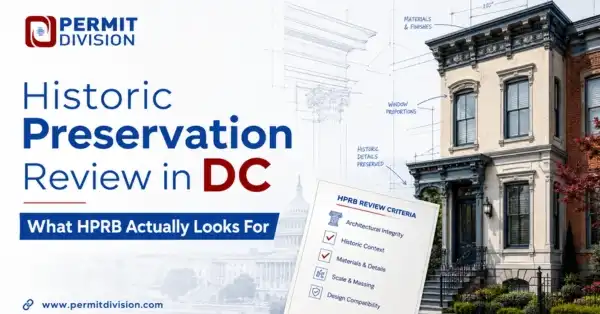
Historic Preservation Review in DC — What HPRB Actually Looks For
Most property owners assume HPRB review is a formality. It is not. The Historic Preservation Review Board is a nine-member panel operating under the DC Historic Landmark and Historic District Protection Act (DC Code §6-1101 et seq.), and it has the authority to deny your project, impose conditions that require full redesign, or defer a decision long enough to blow a construction schedule. Securing permits in DC for any substantial work on a historic property – a rear addition, a rooftop deck, a window opening change, a demolition – begins here, not at the Department of Buildings (DOB). Contractors who skip this step face stop-work orders and fines up to $25,000 per violation under the 2024 Protecting Historic Homes Amendment Act. The city does collect them.
Who HPRB Governs and What "Historic District" Actually Means
DC's 54 historic districts cover approximately 27,000 buildings. Individual landmark designation is not required for HPRB jurisdiction to apply. If a structure sits inside a listed historic district and the DC Inventory of Historic Sites identifies it as a contributing building, the DC Historic Landmark and Historic District Protection Act applies in full.
The review pathway depends on project scale. The Historic Preservation Office (HPO), at 899 North Capitol Street NE, Suite 7100, handles over 95% of permit applications through its Expedited Review process — same-day clearance is possible for in-kind repairs with complete materials. Projects beyond HPO's delegated authority go to the full HPRB. These include demolition of contributing buildings, rear additions exceeding 250 square feet in footprint or 500 square feet across two or more floors, rooftop additions visible from a street, and any significant alteration to a primary facade or front window openings.
One geographic distinction matters: in the Georgetown Historic District, the US Commission of Fine Arts (CFA) — operating through the Old Georgetown Board (OGB) — holds primary review authority over work visible from public space. HPRB retains jurisdiction over subdivisions and exterior work not visible from a street or alley. Owners working in Georgetown need to track two separate review tracks. Projects in all other DC historic districts go through HPO and HPRB only.
HPRB meets monthly on the fourth Thursday, with no August session. All submissions must reach HPO by 5:00 PM on the published filing deadline. HPO staff places cases on either the Consent Calendar (staff recommends approval, no ANC or community opposition) or the full Agenda. An Advisory Neighborhood Commission can request a 45-day deferral. One missed deadline or one ANC objection can add two to three months to a project timeline.
Five Criteria the Board Applies to Every Application
HPRB measures proposals against the Secretary of the Interior's Standards for Rehabilitation (36 CFR Part 68) and DC's district-specific design guidelines. Five factors consistently drive voting outcomes.
Massing and Scale. New additions must remain subordinate to the original structure. The Board measures subordination by how an addition reads from public space. Rooftop additions and rear additions that rise above the existing ridge line, or that are visible from a street or alley, receive the most scrutiny. Additions set back from the primary facade plane, stepped down in height, and screened from street view move through review with fewer conditions.
Materials Compatibility. New materials must be compatible with the historic fabric but visually distinguishable from it. The Board rejects precise replication of historic detailing on additions – that approach creates what the standards call a false sense of historical development. Masonry repair requires in-kind matching: mortar composition, joint profile, and joint width must match the original. Replacing original wood windows on primary facades with vinyl or aluminium almost always fails review on first submission.
Reversibility. Standard 10 of the Secretary's Standards requires that new work be removable without impairing the essential historic form. HPRB looks for structural separation between additions and original building fabric. A new addition that bonds directly into historic masonry without a clear structural break is unlikely to satisfy this requirement.
Character-Defining Features. Primary facades carry the highest protection. Original masonry, window openings, cornices, porches, and decorative elements are treated as fixed constraints. Enclosing a front porch, cutting new window or door openings on a front elevation, or adding a dormer visible from the street all require explicit Board approval and typically generate the most conditional findings.
Streetscape Context. HPRB evaluates proposed work within the visual rhythm of the block: the spacing, height, proportion, and setback pattern of adjacent buildings. Context photographs and scaled streetscape elevations are required submission materials, and the board uses them. A proposal that passes all other criteria but disrupts the block cadence can still come back with conditions.
Two HPRB Decisions That Show How the Board Thinks
Case 1: Capitol Hill Historic District — 16 3rd Street NE (December 2024)
At the December 19, 2024 HPRB meeting, the Board considered a concept application for a three-storey rear addition at 16 3rd Street NE under Case HPA 24-472. The Board approved the overall scope with one binding condition: the third floor of the rear addition was found incompatible because it obscured the property's rear mansard roof, a character-defining feature. The applicant was required to eliminate the third floor. Rear elevation windows also required centering before HPO could receive delegated final approval. Vote: 6-0.
What this shows is the board evaluates additions not just by what they add but also by what they conceal. An addition that satisfies footprint and setback thresholds can still draw a conditional approval — or worse, a deferral — if upper-floor massing hides an original roofline element.
Case 2: Shaw Historic District — 1017 M Street NW (December 2024)
Under Case HPA 24-430, heard the same day, an applicant proposed partial demolition and reconstruction of a Shaw Historic District building. Two options were on the table: reconstruct as a three-storey building (matching existing height through a salvage-and-rebuild approach) or build at four storeys. The Board approved the three-storey reconstruction as consistent with the preservation act. It rejected the four-storey option as incompatible with the district context. Vote: 5-0.
What this shows: reconstruction in kind survives HPRB review. Adding height above the existing building profile does not, regardless of how the additional floor is designed or justified.
Where Projects Fail Before They Reach the Board
HPRB cases get deferred most often for the same preventable reasons. Missing elevations are the most common: DC's HPO Concept Review requires all four building elevations with dimensions on critical measurements. Submissions that show only the front and rear, or that omit the adjacent streetscape context in color photographs, are returned to the applicant for resubmission. That costs a full monthly cycle.
Incomplete material specifications are a close second. The Board cannot approve materials it cannot evaluate. Plans that list "brick to match" without specifying unit size, color range, texture, and mortar joint profile give HPO staff nothing to work with. ANC coordination failures are a third. ANCs can request 45-day deferrals when they haven't been consulted. For projects that will alter a visible facade or require BZA relief in parallel, notifying the ANC before filing is standard practice — not optional outreach.
How Construction Consulting Services Shorten the Timeline
Professional construction consulting services from preservation-experienced practitioners reduce these risks before the first HPO submission. A qualified consultant audits drawings for completeness against HPO's published submission requirements, confirms that material specifications match the relevant district guidelines, and flags any design elements likely to generate Board conditions based on recent precedent.
That preparation keeps projects on the Consent Calendar rather than the full agenda. Consent Calendar placement means no public testimony, no extended Board deliberation, and no ANC discussion at the meeting. For most residential and small commercial projects, it is the difference between one meeting cycle and three.
Frequently Asked Questions
1. Do I need HPRB approval for permits in DC if my property is inside a historic district but has no individual landmark designation?
Yes. The DC Historic Landmark and Historic District Protection Act applies to any building identified as a contributing structure in the DC Inventory of Historic Sites, regardless of individual landmark status. If your property sits within one of DC's 54 historic districts, contact HPO at (202) 442-7600 or [email protected] before filing a permit application at DOB.
2. Can a permit expediter help move a project through HPRB faster?
An experienced permit expediter with DC historic preservation knowledge manages filing deadlines, coordinates with the assigned HPO staff reviewer, and tracks case placement on the monthly docket. HPRB meets once a month. A single missed deadline delays a project 30 days at minimum. Expediters who understand the Consent Calendar process prepare submissions to the standard HPO staff needs to recommend consent approval, bypassing the full Agenda queue.
3. Are there penalties for work done without HPRB approval?
Yes. HPO issues stop-work orders and requires reversal of non-compliant work. Under the 2024 Protecting Historic Homes Amendment Act, unpermitted alterations in a historic district carry fines up to $10,000 per violation. Wilful demolition or unauthorised alteration without approval starts at $10,000 and can reach $25,000 per violation. The owner must also restore the property to its pre-alteration condition, at their own cost, before any new application proceeds.
Ready to File With Confidence?
Permit Division works directly with property owners, architects, and developers on DC historic preservation permitting — from the initial HPO consultation through HPRB concept and permit review, DOB filing, and inspection coordination.
If your project touches a historic district, do not file at DOB first. Contact Permit Division before submission to confirm your review pathway, assess whether your documentation is HPRB-ready, and build a filing timeline that accounts for monthly Board cycles.
Call us +1 (844) 573 7648 / +1 (202) 967 6566 or submit your project details today.
Article Author

Arobit
Blog Admin
Tags
Latest Posts
-
DC Overlay District Rules for Permits: What Builders Need to Know
-
Certificate of Occupancy — The Permit Everyone Forgets Until It Blocks Move-In
-
ADU Permits in MD & VA: Rules, Restrictions, and Costs for 2026
-
Change of Use Permits 101: Office to Apartments, Warehouse to Gym
-
How Long Does a Restaurant Buildout Permit Actually Take in DC?
Similar Posts
-
DC Overlay District Rules for Permits: What Builders Need to Know
-
Certificate of Occupancy — The Permit Everyone Forgets Until It Blocks Move-In
-
ADU Permits in MD & VA: Rules, Restrictions, and Costs for 2026
-
Change of Use Permits 101: Office to Apartments, Warehouse to Gym
-
How Long Does a Restaurant Buildout Permit Actually Take in DC?
Copyright 2026 -
permit division. All Rights Reserved.Get Your Free Consultation

